Reviving Humoral Medicine
with Dr. Hani El Batal
.png)
🌐 English version available — Click “English” | الموقع متوفر باللغة الإنجليزية
%20(1080%20x%201920%20px.png)
Ibn al-Jawzi’s Statements on the Creation of the Children of Adam
The early scholars clarified—among them Ibn al-Jawzi, may Allah have mercy upon him—that Allah, the exalted, created the human being as a composite of the four qualities: hotness and coldness, dryness and wetness, and that human health is based upon the balance of the four humors: blood, phlegm, yellow bile, and black bile. When this balance is disrupted, the signs of illness appear, and treatment is carried out either through diet or medication, according to the temperament that predominates in the body.
In this article, we present a concise summary of these principles as transmitted in the books of Islamic medicine. We explain the four temperaments, the signs of each temperament, and the foods suitable for each, as established by the authorities of this discipline. This provides beneficial guidance for preserving health and preventing illness in a manner that accords with natural disposition (fitrah), the Sunnah, and sound experience.
%20(1200%20x%20630%20px)_e.jpg)
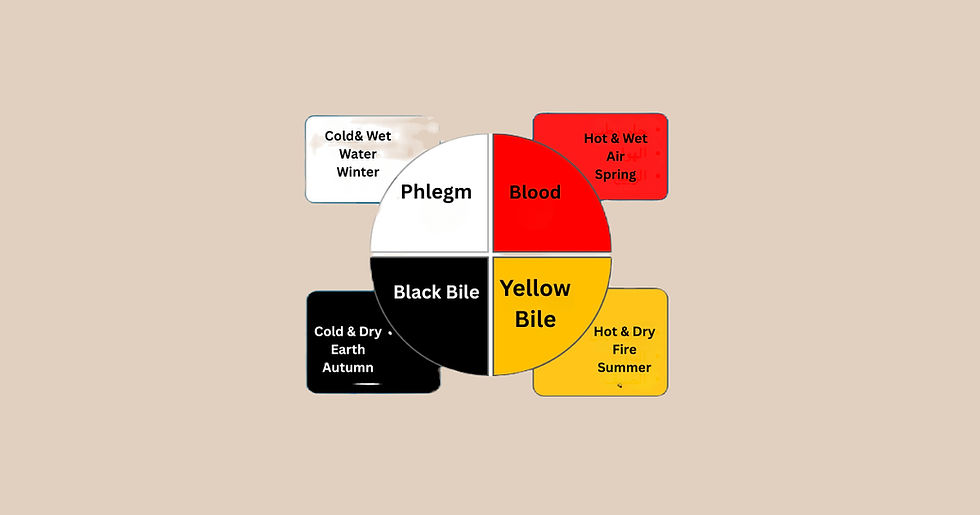
Al-Ḥāfiẓ Ibn al-Jawzī ([1]) mentioned in his book Talbīs Iblīs ([2]) that Allah, Exalted and Glorified, created the children of Adam upon hotness, coldness, dryness, and wetness, and made their health ([3]) dependent upon the moderation of the humors ([4]): blood, phlegm, yellow bile ([5]), and black bile.
His statement, “Allah, Exalted and Glorified, created the children of Adam upon hotness, coldness, dryness, and wetness”, means the four temperaments, and what results from their combinations—namely hot-wet, cold-wet, hot-dry, and cold-dry. Among people are those who are moderated between hotness and coldness, wetness and dryness; and among them are those who are hot and wet (sanguine in temperament), cold and wet (phlegmatic), hot and dry (yellow bile dominant), or cold and dry (black bile dominant).
His statement, “and He made their health dependent upon the moderation of the humors—blood, phlegm, yellow bile, and black bile”, means that a person is physically healthy when his humors are moderate in their proper proportions, such that blood predominates, followed by phlegm, then yellow bile, then black bile—this being the proportion of the moderate temperament.
Preservation of health is achieved for one who possesses a moderate temperament between hotness and coldness, wetness and dryness, through proper management of the six essentials for life—especially food and drink—so that one eats and drinks with moderation from hot, cold, wet, and dry foods.
As for one who does not have a moderate temperament, he eats by opposites. If his temperament is harmful, he may be cured by consuming suitable foods. Physicians have said: “Many diseases are repelled by food alone and not by medicine alone.” That is, if one knows how to eat properly, the illness will disappear without the need for medication. This is because most foods are medicinal in nature—they are nourishment for the body and medicine for it as well. But if one takes medicine while neglecting dietary regulation, the cause of the disease does not disappear and the illness returns repeatedly—such as when the cause of disease is hotness and one continues to consume hot foods, or when the cause is coldness and one consumes cold foods.
The Sanguine (Hot-Wet) Temperament
Whoever is hot and wet (sanguine) is characterized by: heaviness of the body; heaviness especially at the roots of the eyes, the head, and the temples; redness of the face and eyes; bodily swelling; sweetness of the mouth upon waking; stretching and yawning; dullness of the senses; persistent drowsiness; bleeding from the gums; fatigue without prior exertion; and a pulse that is large, soft, and tending toward rapidity.
He eats cold and dry foods, such as: spleen, corn, barley, starch, lentils, dried fava beans, potatoes, cauliflower, peas, coriander, sour tomatoes, unripe grapes, mandarins, navel oranges, grapefruit, sour quince, sour pomegranate, unripe peaches, unripe nectarines, sour cherries, sour kiwi, sour loquat, hawthorn, sumac, vinegar, tamarind, ice, and roasted coffee.
.
The Yellow Bile- Dominant (Hot-Dry) Temperament
Whoever is hot and dry (yellow bile-dominant) is characterized by: yellowing of the complexion and eyes with sunken eyes; bitterness of the mouth upon waking; roughness and dryness of the tongue; dryness of the nostrils; enjoyment of cool breezes; intense thirst; rapid breathing; weak appetite; nausea; stinging and burning in the stomach; and a rapid, narrow, firm pulse.
He eats cold and wet foods, such as: trotters, fish, crab, lettuce, purslane, Armenian cucumber, cucumber, green fava beans, green beans, spinach, zucchini, pumpkin or squash, dandelion, truffles, mushrooms, molokhia and mallow, sheep’s milk, yogurt and sweet labneh, sweet cheese, soft cheese, cream, watermelon, apricots, sweet pomegranate, sweet quince, sweet black peaches, pineapple, papaya, sweet Moroccan lemons, sweet clementines, sweet nectarines, barley water, and rose water.
The Phlegmatic (Cold-Wet) Temperament
Whoever is cold and wet (phlegmatic) is characterized by: paleness and flabbiness of the body; facial puffiness; little thirst; weak digestion; excessive thick saliva; sour belching; drowsiness; excessive sleep; heaviness greater than that of the sanguine; laziness; lax nerves; dullness; and a slow, soft, broad pulse.
He eats hot and dry foods, such as: mutton, camel meat, rabbit, fish roe, quail, partridge, small birds, safflower, mint, thyme, basil, radish, artichoke, green fennel, arugula, salt, onions, garlic, eggplant, cabbage, fennel seeds, anise, cumin, celery, cress seeds, fenugreek, black seed, black pepper, red pepper, mahaleb, cardamom, mustard, caraway, ginger, cinnamon, turmeric, tea, hazelnuts, walnuts, chestnuts, honey, unroasted coffee, and orange blossom water.
The Black-Bile Dominant (Cold-Dry) Temperament
Whoever is cold and dry (black bile-dominant) is characterized by: darkening of the face and loss of its clarity; dryness of the body and mouth; little sleep; sourness of the mouth upon waking; heaviness less than that of the phlegmatic; constriction of the stomach; and a slow, firm, narrow pulse.
He eats hot and wet foods, such as: lamb, tail fat, harīsa, chicken, wheat, turnips, carrots, asparagus, chard, beets, ghee, butter, sweet white mulberries, figs, sweet apples, sweet grapes, melon, sweet mango, avocado, sugarcane, dates, fresh dates, raisins, coconut, sesame, pistachios, large pine nuts, almonds, cashews, sweet grape molasses, date molasses, black olives, and sweet cherries.
Conclusion
I say: a physician knowledgeable in humoral medicine guides you in preserving your health when it is present, and restores it to you when it is lost—through food and medicine. He distinguishes the causes and signs of health and illness, and the appropriate food and medication according to the dominant temperament. If a physician treats using food alone, he has attained success, for this is easier on the patient’s soul.
(1) Ibn al-Jawzi, Abū al-Faraj ʿAbd al-Raḥmān ibn Abī al-Ḥasan ʿAlī ibn Muḥammad al-Qurashī al-Taymī al-Bakrī, was a Ḥanbalī jurist and scholar. He was born in Baghdad and died there (510–597 AH).
(2) Talbīs Iblīs, p. 362, Dār al-Kitāb al-ʿArabī, Beirut.
(3) In medical terminology, health (al-ṣiḥḥa) is a state in which the human body, in its temperament and composition, is such that its functions proceed soundly and correctly.
(4) In medical terminology, bile (al-mirra) is one of the four humors. Linguistically, mirra denotes strength and intensity. The term is applied to yellow bile because it is the strongest of the humors, and also to black bile because it is the most severe due to its thickness, firmness, and stability.
(5) In medical terminology, a humor (al-khilṭ) is a moist, fluid substance into which food is first transformed. The bodily humors are four: blood, phlegm, yellow bile, and black bile. Among humors are those that are beneficial, which are suitable to become part of the substance of the nourished body—either alone or with others—and are generally fit to replace what is lost through dissolution. There are also corrupt humors, which are not suitable for this purpose.